








Article: From Seville to Kyōto: kōdō and Incensum
From Seville to Kyōto: kōdō and Incensum
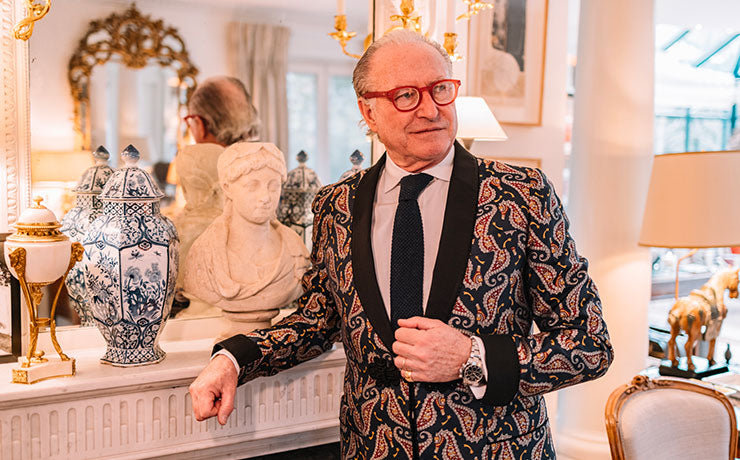
In Seville, incense fills the streets during the processions. In Japan, it is listened to in silence, during a ceremony called kōdō. Master perfumer Alberto Morillas has brought these two worlds together in one fragrance: Incensum.
Picture a quiet room, somewhere in Japan. Guests are seated in a circle. A small ceramic cup is passed from hand to hand. Inside, a tiny piece of precious wood is gently warming. Each guest brings the cup closer, covers it with one hand, breathes in, then passes it on to their neighbour. No one speaks. They listen to the fragrance.
This scene is kōdō. It is also where Incensum begins.
Kōdō, the ‘way of incense’
Kōdō is a Japanese art in which the scent of precious woods is appreciated through very precise gestures. In Japan, it is one of the three great arts of refinement, alongside the tea ceremony and the art of flower arranging, ikebana. Born of Buddhist rituals, it has become a secular art: a moment of attention and sharing, but also a game.
Wood from the sea. Incense reached Japan in the 6th century, along with Buddhism. Legend has it that in 595, a log of fragrant wood washed up on a beach on the island of Awaji. The islanders burned it, discovered its scent and offered it to the court.
An art more than five centuries old. In the 15th century, Ashikaga Yoshimasa, a shōgun with a passion for fragrant woods, asked two experts to classify his collection. They founded the two schools that still teach kōdō today.
How the ceremony unfolds
In kōdō, the wood is not burned: it is warmed. The aim is to release its scent without producing smoke.
- The cup. A small ceramic cup, the kōro, is filled with very fine ash. A small piece of hot charcoal is hidden inside.
- The ash. The ash is shaped into a small cone with regular lines.
- The mica. A thin plate of mica, a transparent mineral, is placed on top. It shields the wood from direct heat.
- The wood. A sliver of precious wood, barely larger than a grain of rice, is laid on the mica. It is often agarwood, the rare wood from which oud is also obtained.
- The listening. The cup is passed around. Each guest holds it in one hand, covers it with the other and breathes in slowly. The Japanese call this moment monkō: ‘listening to incense’. It is not simply about smelling, but about taking the time to feel.
A guessing game. Kōdō is also a game. Several cups are passed around, and the guests must recognise the woods. In the best-known version, they have to guess which of five cups contain the same wood. To describe what they smell, initiates speak of flavours: sweet, sour, hot, salty, bitter. A vocabulary very close to that of perfumers.
Alberto Morillas’s Incensum
For Alberto Morillas, incense is not first and foremost Japanese. It is a childhood memory from Seville. During the processions, the clergy swung their censers, and the swirls of smoke perfumed the streets of the Andalusian city. That mysterious scent stayed with him, though he did not yet know that one day he would revisit it in a fragrance for Mizensir.
Years later, kōdō gave him the other half of the story. Seville and Kyōto seem worlds apart. Yet the same gesture is made in both: entrusting a scent to heat. The word ‘perfume’ itself comes from the Latin per fumum, ‘through smoke’.
Both incenses also share the same origin: a wound in the tree. Frankincense resin flows when the bark is cut; agarwood forms when the tree defends itself against an injury. Only the ritual differs. In Seville, incense swings above the crowd. In Kyōto, it passes from hand to hand, in silence. Incensum brings these two images together.

The fragrance. Alberto Morillas did not set out to copy a precious wood. He wanted to recreate an atmosphere: what the guests smell as the swirls of smoke spread through the room.
| Notes | What you may sense | |
|---|---|---|
| Top | Ginger | The spark, the ember awakening beneath the ash |
| Heart | Smoked incense, myrrh | The swirling smoke, the warmth of resins |
| Base | Woodleather®, papyrus wood | Deep, smoky woods that linger on the skin |
The key ingredient: pyrogenated incense. At the heart of Incensum, Alberto Morillas uses a rare material. It is obtained by heating frankincense resin to a very high temperature, rather than distilling it in the usual way. The heat creates scents that do not exist in the fresh resin: smoky, slightly tarry notes reminiscent of warm ash and smouldering incense. It is exactly the smell of a censer as the resin melts on the embers. The memory of Seville, captured in a bottle.
Why ‘Incensum’? It is the Latin word for incense. Latin is the official language of the Catholic Church, the language of the ceremonies the young Alberto watched passing through the streets of Seville. The name is a direct nod to that memory.
A fragrance to listen to. In Japan, it is said that fragrance heals both soul and mind. Incensum does not impose itself: it reveals itself little by little, just as one listens to a precious wood resting on its mica plate.
Listen to Incensum
Kōdō teaches slowness: a piece of wood, a little heat and our full attention. Incensum keeps the essentials – smoke, resin, wood and silence – to be worn on the skin.
To extend the journey, we have created the Incensum soundtrack: Japanese funk, jazz and city pop from the 1970s and 1980s. Tokyo musicians reinventing American soul and jazz in their own way: yet another meeting of East and West.
Listen to the Incensum | Soundtrack playlist on Spotify
Incensum, 100 ml eau de parfum, is available online and in our boutiques in Geneva and Megève. Come and listen to it with us.